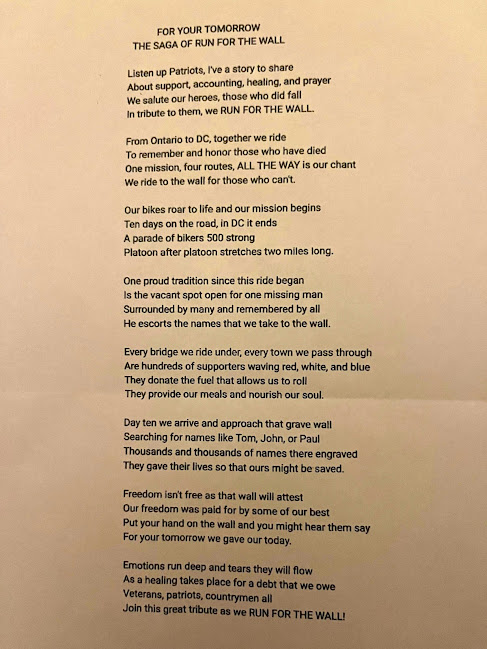
May 23, 2026 – in Washington DC


If you have never been to the Vietnam Wall, this is how you find the names.


Kim plays Amazing Grace as the RFTW family walks the Wall.


It has been a very long journey to get here.
The RFTW Plaque is placed at the apex of the Vietnam Wall.
MISSION COMPLETE!!

***********************************

-


The military guard at the Tomb of the Unknown Soldier is changed in an elaborate ceremony which happens every hour on the hour from October 1 through March 31, and every half hour from April 1 through September 30.
Twenty-four hours a day, soldiers from the 3rd U.S. Infantry Regiment, known as "The Old Guard," stand watch over the Tomb. The Tomb Guards, also called Sentinels, are chosen for this prestigious and highly selective post only after rigorous training and a demanding series of examinations (see below). The Old Guard has held this distinguished duty since 1948.
The Tomb Guard marches exactly 21 steps down the black mat behind the Tomb, turns, faces east for 21 seconds, turns and faces north for 21 seconds, then takes 21 steps down the mat and repeats the process. (The number 21 symbolizes the highest military honor that can be bestowed, the 21-gun salute.) Next, the Sentinel executes a sharp "shoulder-arms" movement to place the weapon on the shoulder closest to the visitors, signifying that he or she stands between the Tomb and any possible threat.
***********************************************************************************
Several years ago on this incredible journey, we had a speaker that said this, and it really stuck:
Teach all to honor those that protect our country.
Always be loyal to those serving.
And never leave anyone behind.
So therefore, the Run must never stop.
POW / MIA Poem
We need to remember them every day.
They went to fight in a place so far away,
They gave their all when their country sent out a call
Not ever knowing that their name would end up on the wall,
No matter how we honor them no matter what we do
We should always remember that they paid the highest price
For the red, white and blue.
So when you look up at the flag flying in the wind on a clear blue day
Remember it’s there because of the
POW and MIA
*****************
I hope this daily report has given you some idea of our mission. It is a grueling trip. Long day, short night, 4;30 AM wake up calls…. This starts to wear on you. Our trip was only 10 days. Think of our troops in extreme hot and cold days. They have a lack of sleep, long days......they stand to keep us safe a lot longer than 10 days.
Here are a few fun facts about our trip. Others are very similar.
- Temperature ranged 32-110
- We traveled in 14 states + Washington DC
- From Loveland, OH to Ontario, CA to DC to Loveland, OH – 6200+ miles
- Thanks for all the thoughts and prayers.
We did not pay for meals on our mission. Every town we stayed in welcomed us, fed us, and prayed for our safety. The support, encouragement, respect that the Americans have for the mission is incredible. There is an unbelievable amount of time hanging banners, kids making bracelets, making pocket patches, hanging flags on the overpasses, closing down streets, organizing volunteers for meals, setting up fuel stops. and the list goes on.
100s, 1000s of hours given by so many to make this happen: route coordinator, state coordinators, missing man coordinator, staging team, fuel team, hydration team, road guards, medical personnel…..and the riders themselves. The logistics to get that many people across the country has to be done by so many.
We continually asked each other: What time is it? What time zone are we in? What day is it? What state are we in? But there is one thing we knew the answer to: What was our mission?
Mission Statement of RFTW : To promote healing among ALL veterans and their families and friends, to call for an accounting of all Prisoners of War and those Missing in Action (POW/MIA), to honor the memory of those Killed in Action (KIA) from all wars, and to support our military personnel all over the world
I have sent many quotes thru the last 10 days. Here are my last few:
U - Unselfish
S - Service to
A - America
It is foolish and wrong to mourn the men who died.
Rather we should thank God that such men lived.
General George Patton
Say their names. Tell their Stories. Never Forget.
On the Run, we said the Pledge every day. I see our flag and have taken pictures of it all week. Every time I see it waving in the air, it is telling me I am free. And that right is protected by our men and women. Let's continue to try and bring them all home.
HOW FAR ARE WE GOING??? ------ ALL THE WAY
HOW FAR ARE WE GOING??? ------ ALL THE WAY WHY DO WE RIDE?????----- FOR THOSE WHO CAN'T
MISSION ACCOMPLISHED!!!
One more set of prayers please, and that is to get everyone home safely from DC and continue to pray for all service men and women, past and present.
A few days ago Jim read this in our morning meeting.
There needed to be a box of tissues on every table:
Come Visit My Grave by Jim Rolfes
I am a veteran under the sod
I’m in good company, I’m up here with God
Come to my grave and visit me
Today is Memorial Day throughout this great land.
There’s Avenues of flags, Parades and Bands.
I can hear the music, the firing squad and taps.
Here come my comrades, the Legionnaires, the blue caps.
One of the just put a flag on my stone.
Some day he will have one of his own.
Some think of this day as just a free of toll.
While others are busy working the soil.
They say they have plans, other things to do.
Don’t put us aside as you would an old shoe.
Come visit my grave in this cemetery so clean.
That is what Memorial Day means.
There are many of us lying in wakeless sleep
In cemeteries of green and oceans of deep.
It’s sad that for many who fought so brave
No one comes to visit their grave.
They die so you could have one whole year free
Now can’t you save that one Day for me?
There are soldiers, sailors, airmen up here
Who went into battle despite of the fears
I’ve been talking up here to all those men
If they had to do it over, they’d do it again.
Look someone is coming to visit my grave
It’s my family, for them my life I gave.
My wife, I remember our last embrace,
As I left the tears streamed down your face.
I think you knew that day I shipped out
I won’t return, your life would be turned about.
There’s my daughter I used to hold
Can it be that you’re nearly twenty years old?
Next month is to be your wedding day.
I wish I could be there to give you away.
My son’s here too, Dad’s little man.
Always love you Country, do for it what you can
There is one thing that really did bother
Is seeing you grow up without the aid of your Father.
I wish you could all hear me from up above
That’s’ a father’s best gift to his children is love.
And what better way to prove my love to the end
Is that man lay down his life for his friend.
I see it’s time for you to go home
Your visit made it easier to remain here alone
Don’t cry honey, you look too sad
Our children are free, you should be glad
Daughter, thanks for the bouquet so cute
Thank you son for that salute
Come again, I forgot, you can’t hear from up here
But I know you’ll come visit me again next year
I hope all veterans are treated this way
On this day to remember, Memorial Day.
I leave you with this song:
Arlington (by Trace Adkins)
I never thought that this is where I’d settle down
I thought I’d die an old man back in my hometown
They gave me this plot of land
Me and some other men, for a job well-done
There’s a big white house
Sits on a hill just up the road
The man inside
He cried the day they brought me home
They folded up a flag and told my mom and dad
We’re proud of your son
And I’m proud to be
On this peaceful piece of property
I’m on sacred ground
And I’m in the best of company
I’m thankful for those thankful
For the things I’ve done
I can rest in peace
I’m one of the chosen ones
I made it to Arlington
I remember daddy brought me here when I was eight
We searched all day
To find out where my grand-dad lay
When we finally found that cross
He said, “Son this is what it costs
To keep us free”
Now here I am, a thousand stones away from him
He recognized me on the first day I came in
And it gave me a chill when he clicked his heels
And saluted me
And I’m proud to be
On this peaceful piece of property
I’m on sacred ground
And I’m in the best of company
I’m thankful for those thankful
For the things I’ve done
I can rest in peace
I’m one of the chosen ones
I made it to Arlington
And every time I hear twenty-one guns
I know they brought another hero home to us
We’re thankful for those thankful
For the things we’ve done
We can rest in peace
‘Cause we are the chosen ones
We made it to Arlington
Yeah, dust to dust
Don’t cry for us
We made it to Arlington
God bless the USA.

NEVER FORGET !!!!!