Wednesday, May 11, 2016

May 11, 2016 - Day 2 to CA

For those that did not see the comment on yesterday's post from Jenny, here it is:
For our non motorcycle friends, the motorcycle won't start without the key fob... quite an important item to keep track of. If you zoom in on our picture, you will see where Ken laid the key fob....right in front of this cooler. Interesting fact...a key fob was lost last year on then trip to DC....common denominator....Larry and Jean. Hummmm. Just saying....

So here is the picture and yes the keys are on the seat. Sooo I have learned my first lesson this trip, do not interrupt Ken and take him out of his routine.  I guess that means this is MY fault. HaHa


We walk out of the hotel and Larry yells, rain is back "gear up".


This is getting old.  We road in it the first 80 miles then the next 80 if rained off and on.  At least it was not 40 degrees.  It was 68 when we started.

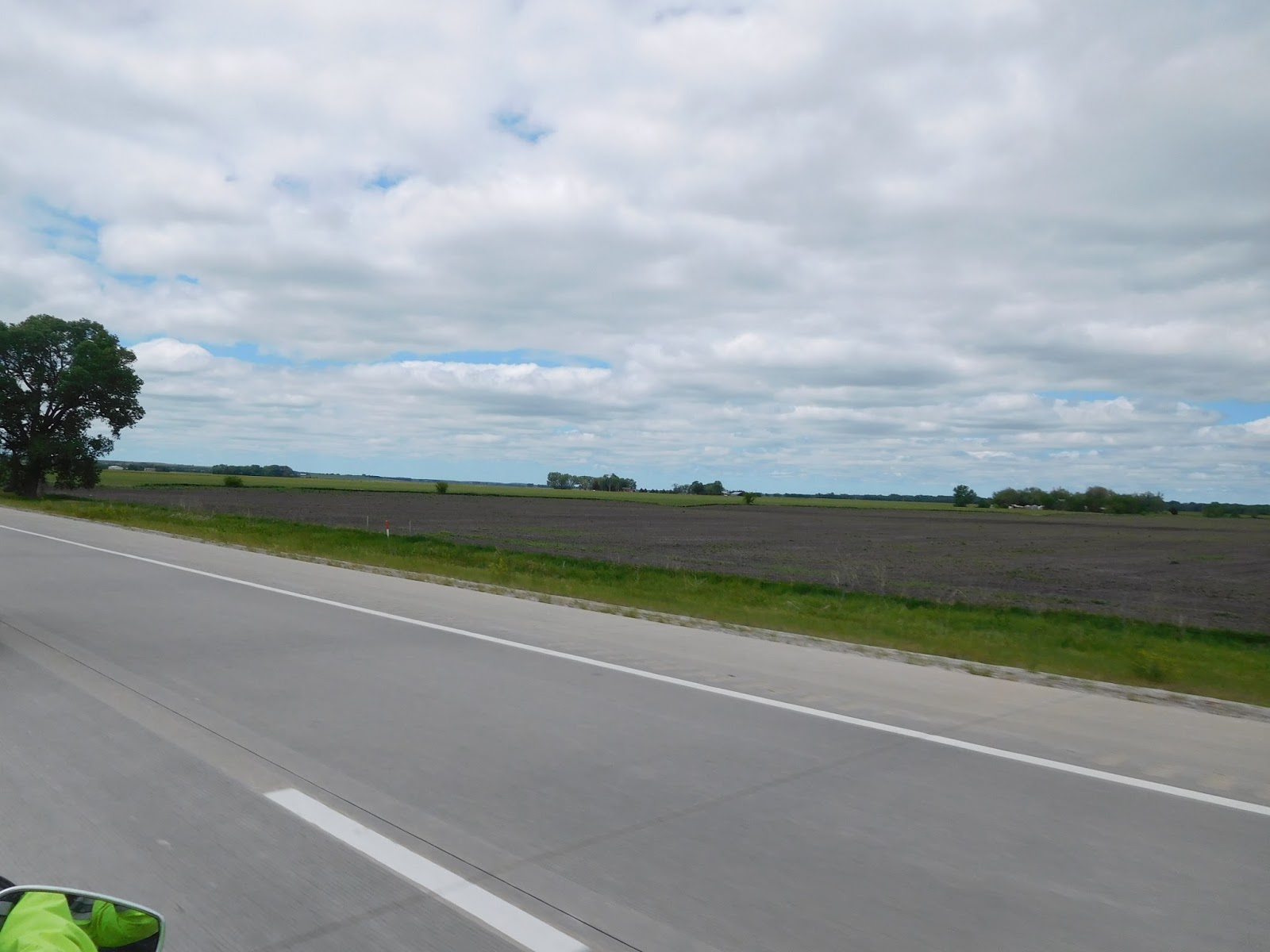
We then get into Kansas.  Can you say "FLAT" and "WINDY".


This is what we saw for MILES!!! Gray sky and green grass.
  

Every now and then you would see a little hill.  Still there is nothing there.  You see cows but no farm any where around.  Very few trees.


So not much to take pictures of so Ken and Jenny got their pics taken.

"Catfish"

"Lady Jen"

Then we were met with a lovely aroma.  For those that cannot tell this is a semi carrying cows.

We passed Fort Riley. Only got a few pics.


The day then started to brighten up and over the next few hours, we finally got blue sky.  You can see the blue more and more in each picture. Blue skies nice but the wind got stronger as the day went on.  It was a head wind at about 1:00.  Tough on everyone. 


Finally some beautiful colors but still flat.


Take a look at the American flag in the picture.  Out in the middle of no where.  It reminded me of one of the reasons why we were taking our trip:  Riding for those the cannot.

We saw a herd of bison.

Pretty cool. Check out all the flags.

If you can,  look at the flags on Jenny's bike.  The POW/MIA flag flew forward and the US flag flew backward.  It was like this most of the afternoon.  Kind of weird.  Yesterday both flew same way, backward like you would think.  (You may have to double click the picture to make it bigger to see it)


Then we hit a "wind farm". There were hundreds of them.  So I was thinking, they just look like they are put out the randomly.  I googled it, for fun:

The simple answer is that wind farms are built in places where the wind is strong and steady

Wind forecasters look at two kinds of data. First, they take wind measurements at a potential wind farm site for a year or so. Then they compare that data with long term measurements in the same region going back fifty years or more, using information gathered by weather balloons, satellites, and observations at airports.
They feed all the data into powerful computer models that provide an accurate and detailed portrait of the site’s wind resources past, present, and future.

Accuracy Is Key!

The more accurate that portrait is, the better. Because wind is extremely sensitive to changes in temperature, terrain, humidity, and dozens of other factors. A change in elevation from one part of an area to another can make a big difference in wind speed.
So wind forecasting computer models need to take into account as many elements as possible, including potential changes such as climate change, loss of trees, and land development.
No model is perfect, but wind forecasters have become very good at telling wind farm developers how much wind they can expect, and how much energy their turbines will produce

 Few more different cloud formations.


If you can look real close in the middle of the picture, is a crop dusting plane.  Something you do not see much any more.  It was pretty cool.

 Had to make a quick stop to put on more clothes.  Temps dropped pretty quick when the sun went down.

Back to clouds. We were going to try and make it to Limon.  Ken was watching the weather and we decided to stop in Goodland KS.  More rain.

Here are pics from the hotel tonight.  Cloud line just hung there.


We went 540 miles today all on I-70. We stopped at Goodman KS for the night
Start the day at 68 degrees and got to about 73.
I believe tomorrow will see more rain.  FUN FUN!!

Tuesday, May 10, 2016

May 10, 2016 - Day 1 to CA

Forgot to add the picture of Mike Albrinck  with his wife.  Looks great 50 years after serving.  He currently has 3 kids.  2 have serve overseas as part of the National Guard.  Brittany was in Kuwait for 6 months and Brian was in Afghanistan for 6 month.  Following in dad's footsteps.
Several people have asked about what we pack and how much will fit in the compartments of the motorcycle.  Here is a pic of the items in the suitcase that fits in the tour pack ( the one on the back of the bike). The rain gear and other items are already in the saddle bags.  You have to learn to pack with only few items you do not mind wearing several time over the next 3 weeks (washed several times of course) .


Well as most of you know we have lots of rain the last few days and today was no exception.  What a way to start off the trip.  We left with rain gear on and headed to Florence to meet Jenny ( aka "Lady Jen") and Ken (aka "Catfish") Ward for breakfast.  The sky was trying to let the sun thru as we left Loveland.


As we cross the river to KY, looked liked we have have blue skies.


A little recap about the Wards. Ken was in the Navy from 1977-1981.  No war at this time. He served in Norfolk VA. He was electronic warfare technician and always looking for enemy on radar.
He was our platoon leader last year for RFTW (platoon 3)  and was the central route coordinator in 2014. This year he will be a road guard.   This is his 9th year and is currently the Treasurer for RFTW. This is a very big task. His wife Jenny is also very involved in the Run. Larry and I will be assisting Lady Jen in her tasks this year.  We will get an education of some of the logistics it takes to get 300 people across this beautiful country. We will get more details on this later.

So we meet them at Cracker Barrel, and as we are sitting waiting for our food, I receive a few text wishing us safe travels.  I tell Larry he was on copy and should have also gotten them.  At that point he tell me he does not have his phone.  Left it at home.  Has the case for it but no phone. We all got a good laugh because it is normally me that forgets my phone.  I was able to get a hold of our neighbors who were so kind to Fed-ex it to CA for us to pick up there.  Thanks Kevin and Carol.

All geared up and ready to go!!


We are off  

Not long and the rains came.  Sooo much fun... NOT!!!

We did get a good amount of nice weather.  This is Ken and Jenny.  I guess you all figured that out.


Heading  thru Illinois the sun was out.  If you read blog last year , you know I am a sucker for the scenery.  Great colors. 

Check out the clouds, they look like roles of cotton.

Saw a lot of fields like this.  Must have been hit with lots of rain.  

As we head into Missouri, we see the St. Louis Arch.  

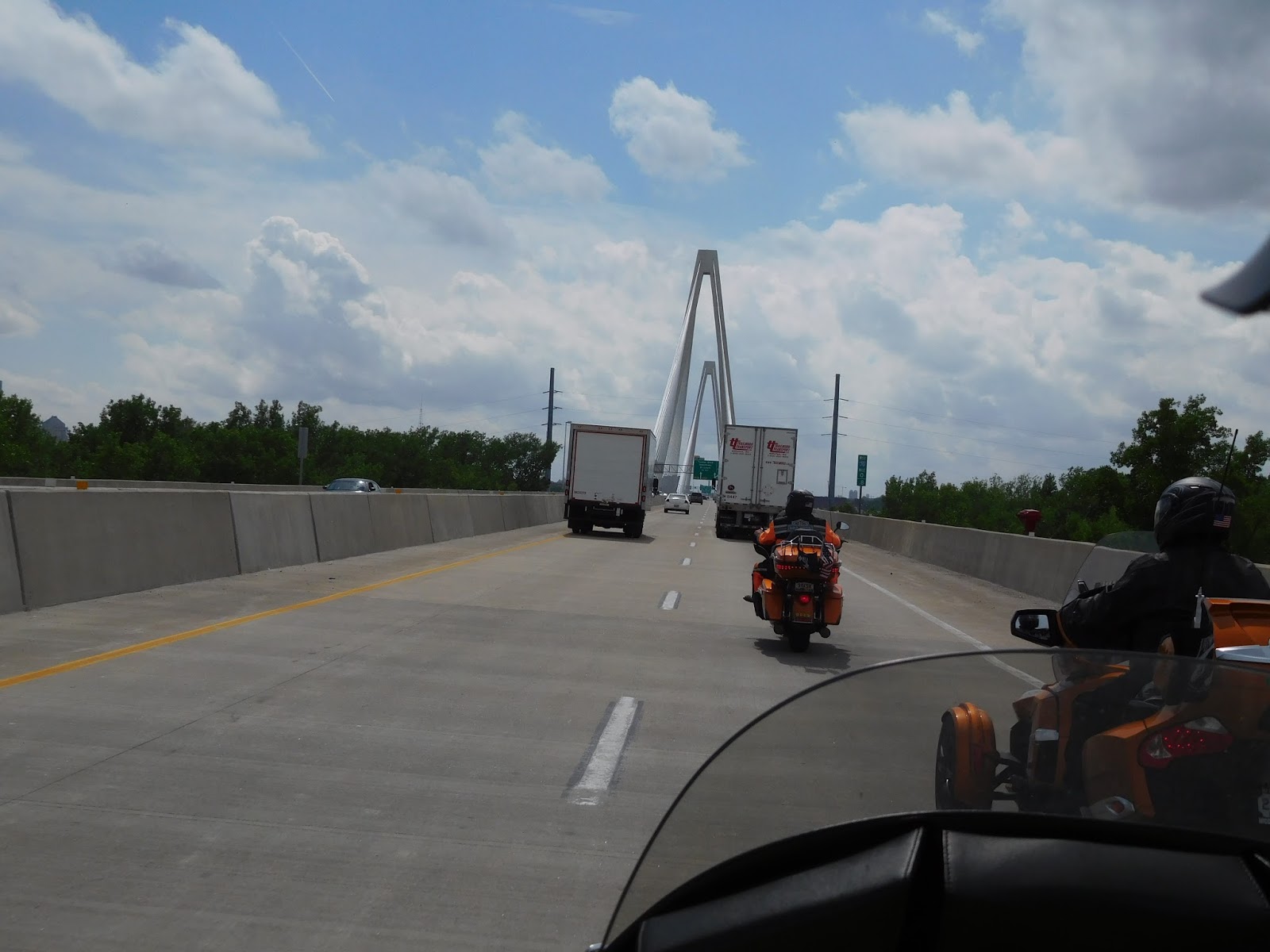
Then head across the Mississippi River.  Check out the bridge.  Pretty unique design.

Sorry have to turn your heads on this one.  Have not figured out how to flip it.  :-)


The Great Mississippi River

The rest of the day we see lots of green fields and blue skies. 
 Nice puffy white clouds to end the ride for the day.
For dinner, we met with Willy and his wife.  He was in Platoon 3 with us last year.  Due to surgery on his foot he was unable to ride this year.  He rode in 2013, 2014 and 2015.  Hope you are back on the mend for 2017.  Was great seeing you.  They live in Mexico, MO.

Forgot to mention that at some point between rain and sun, Ken lost his keyfob for his bike.  He clams it was my fault. Really!!!  I never touched.  In the recap, he was putting on his rain gear and laid it on the seat, he thinks.  Then I asked for a picture and thinks he forgot to pick it up.  Anyway, good thing we always bring a second one.  Jenny had one.  He will get a new one in CA.  See Aaron, happens to the best.......

We went 516 miles today.  We are taking the route backwards.  So we hit I 71 to Louisville, then picked up I 64.  When we got to St. Louis, we got on I-70.  Stopped at Columbia MO for the night.

We started out at 55 degrees with rain and ended at 82 and sunny skies.  Hope tomorrow is like the end of the day.

Monday, May 9, 2016

May 9, 2016 - READY TO GO

Last year, Larry and I rode for his brother.  This year we would like to ride for 2 people, both served in Vietnam:  Glendon Sergent, Larry's brother-in-law, and Mike Albrinck, my Uncle. Neither were physically in Vietnam but both server our country.

Glendon Sergent.  He served during the Vietnam War 1963-1967 in Newport RI at Melville Naval Base.  He was a cook and worked around the shipping docks.  He would help with “feed water” to the ships.  This gave them fresh water.  Once the shipped got beyond the 12 mile mark, they could make their own fresh water.  He also worked on the tug boat to help take the carriers to the peers. Moving ships in and around in port as needed.  The tugs would push them to the peers to be tied up.  As a sailor they had to tie a "neckerchief" they wore. He told us if it was not done right, they would about yank your head off and make you tie it again. Had to be perfect.  I would expect nothing else from the military.  
He actually still had his and we will be carrying it with use to the Wall. “Glen” I got it tied (uTube LOL).


Mike Albrinck   I was 9 years old when he went into the service.  I remember as a kid being in the living room seeing him in his uniform before he left.  He was larger than life. I never gave that much thought until I talked to him today.   I called him last night and he had some time to puts some notes together before I talked to him. He was a medic that served in Japan.
Picture before he left


 VERY interesting…


US Army Medical During the Vietnam War
There is very little information given out about the wounded during any war, and this was true for the Vietnam War.  This could provide motivation for the enemy.  However, the US Army and the US Air Force had a very extensive and coordinated operation with the casualties during the war.  The US Navy and US Marine Corp had similar operation.
1-      The Army Corpsman was the first the come in contact with the wounded.  He evaluated who was KIA, and he then “triaged” the wounded to be evacuated by helicopter.  The most severely would be evacuated first.
2-      Wounded were then taken to a field hospital where they were further “triaged” for surgery, if needed.
3-      1967, 1968, and 1969 was the most intensive actions of the war as General Westmorland put into action “Search and Destroy”.  There were many company size units deployed all over of Vietnam.  The contact was often and it created a lot of casualties.  North Vietnam and Viet Cong attacked when they had the advantage.
4-      There were between 150 and 200 KIA each week during these years, which is about 8,000 per year.  I think this may be a conservative number
5-      For every KIA there were about 3 casualties that had to be evacuated from the field.
6-      So this meant there was about 400 – 600 casualties weekly.  This created a problem because of the treatment that was needed and the medical personnel needed to attend to their injuries. There was another problem, there was another 400 to 600 casualties coming the next week.  
7-      So there was about 1500 wounded per month. 
8-      About 97% of all the casualties that were able to get evacuated by helicopter from the field survived.
9-      To solve the problem the casualties were transported as soon as possible from Vietnam to one of the five hospitals in Japan that surrounded Tokyo.  The Marines had a hospital in Yokosuka, Japan, which was south of Tokyo.
10-   US Air Force flew the casualties from Vietnam on KC-141.  Especially set up for medical evacuation.
11-   Patients were “triaged” again.  They were assigned to one of the hospitals. 
12-   The time an individual was injured in Vietnam and landed in Japan could be between 48-72 hours.   
13-   I was stationed at the 106th US Army General Hospital, which was the largest and we received the most severely wounded, and the 106th was the “Burn Center” where all burn casualties from all branches of the military were assigned.
14-   We had a 1000 bed capacity.  After the Tet Offensive in 1968, the 106th and the other hospitals were over capacity.
15-   One of the most amazing part of the operation is the record keeping that had to follow the patient.  Also, when that patient went on the helicopter to one of the hospitals, there was a bed waiting for him in the proper ward that specialized in his wound.   They were transported off the helicopter the bed assigned to him.  No waiting !     
16-   When you think that there over 200 patients going in out of the 106th each day, there was a lot of work keeping the records up to date.  No computers.  All paper and typing.
17-   During the Tet Offensive there was as many as 400 being transferred a day, some coming in and some going out.
18-   The patients were able to stay a maximum 60 days (maybe 90).  After 60 days they had to be returned to Vietnam or sent to an Army hospital in the USA.
19-   There was always a lot of pressure on doctors who had to make the decision of how long to keep a patient before sending him back to Vietnam.   It was difficult to send a soldier back to the same unit where he became a casualty.  We had one person who made it to the 106th three times.
20-   When a soldier returned to Vietnam, the soldier was considered fixed and ready for combat. 
21-   The patients that were going back to the USA were kept long enough to make sure they could make to long flight medically.   No one wanted to be responsible for someone not making back to the USA.  Some were kept long enough to adjust psychologically to the event that had changed their life.

These few pictures and this short note are dedicated the many who have given so much in that far way place, and all US Army, US Air Force, Navy and Marine, medical and non-medical  who helped to help all service personnel in all branches after the event that changed their lives forever.

SP/4 Michael H Albrinck -  106th US Army Hospital,   February 1967-April 1968

 Guys coming off a helicopter
 Could fit 6 per helicopter, 3 per side

They also came in by bus.   Hopefully you can see this picture. ( Double click on it to get a larger image).  The guy in the foreground checks the paper work of every soldier. The person to the right, is the doctor.  He would check the status of wounded.  The 2 guys standing would be ready to move them to the assigned buildings.


Uncle Mike , thanks for the great pics and summary.  He went back to Japan many years after the war.  The buildings you see  are all down now and there is a beautiful park there.  

Not all of those that served were in the front line or even in the country where the war/conflict happened.  This does not minimize the fact that they have given time from their life and families to serve to keep us safe.  This is same for those that are not actually on the Run with us.  You keep us in your prayer and thought.  We have family members keeping thing going for the 3 weeks we are gone.  Thanks to those.

Give some thought to this:  Any time you see a service man or woman, please take a few minutes to go over to them and thank them for their service.  It only takes a few seconds.  Let them know you appreciate what they are doing.